
CategoriesDigital Strategy

What I’m Trying to Figure Out About the Future of Digital Marketing

The future of digital marketing is often presented as a list of technologies to adopt. That framing is convenient for vendors and exhausting for everyone else.

I am more interested in the tensions underneath the tools. They will shape decisions long after this year’s product names fade.

What happens when production is abundant?

AI can create competent content and variations at low cost. If everyone can produce more, attention does not expand to accommodate it. Selection, distribution, trust and a recognizable point of view become more valuable.

I want to understand whether teams use lower production costs to improve thinking or merely increase volume.

Who controls discovery?

Search, social platforms and AI assistants increasingly answer questions inside their own interfaces. Organizations still need those systems, but they also need durable sources they control. The relationship between reach and ownership is becoming less comfortable.

Google’s AI-search guidance still points creators toward useful, original work. Whether the economics continue to reward that work is an open question.

Can measurement stay credible?

Privacy choices, platform boundaries and complex journeys make complete attribution less plausible. Marketing may need to become better at experiments, contribution and explicit uncertainty instead of promising a perfect customer path.

That could be a healthy correction if leaders accept evidence that comes in more than one form.

Will capability matter more than tools?

The organizations that adapt well may not own the largest stack. They may be the ones that can make decisions across marketing, technology, data, service and governance without turning every change into a territorial dispute.

These are not predictions dressed as certainty. They are the questions I plan to test through research, practice and writing. A useful future will be built by organizations that can learn without surrendering their judgment.

Sources

CategoriesMarketing Leadership

After 25 Years in Digital Marketing, I’m Starting Over

Twenty-five years is long enough to watch digital marketing reinvent its vocabulary several times. Portals became platforms. Hits became sessions. Campaign automation became AI orchestration. Each generation arrives sounding permanent.

I am starting this site again because permanence is the wrong test. I want to examine which ideas remain useful after the interface changes.

Experience can become a trap

Pattern recognition helps. It can also turn into an excuse to stop looking. Familiar debates return in new packaging, but the surrounding conditions do change: customer expectations, privacy, distribution power, production cost and the speed at which average work can be created.

The useful posture is neither awe nor dismissal. It is curiosity with a memory.

The questions have become organizational

Many hard marketing problems now sit between disciplines. A measurement issue may really be a definition problem. A technology failure may begin with ownership. An AI policy affects brand, data, procurement and management.

That is where I expect to spend most of my attention: the operating reality behind the tool.

Why write publicly

Writing forces a claim to become specific enough that someone can disagree with it. It exposes gaps hidden by a meeting or a slide. A public archive also makes changing my mind visible, which seems healthier than pretending every opinion arrived fully formed.

Google’s people-first guidance asks whether content demonstrates first-hand expertise and gives an intended audience something satisfying. That is a better editorial test than chasing volume.

What comes next

I will write about digital strategy, marketing technology, measurement and leadership, with AI running through those subjects rather than replacing them. Some posts will offer a practical model. Others will argue with habits that have become too comfortable.

Starting over does not mean discarding the past. It means bringing forward what earned its place and putting everything else back under review.

Sources

CategoriesMarketing Technology

What AI Should—and Shouldn’t—Be Doing Inside a Marketing Team

AI can help a marketing team move faster. Speed is useful only when the team knows which work should accelerate and where a pause protects customers, brand and accuracy.

The boundary should be based on risk, not enthusiasm.

Good uses are bounded

Summarizing supplied material, producing variations, classifying records, checking consistency and drafting from approved facts can save time. The input is known, the output can be reviewed and the consequence of an error is manageable.

These jobs still need owners. “The model did it” is not a control.

Keep judgment at sensitive points

People should own claims about products, decisions affecting access or opportunity, responses to vulnerable customers, use of confidential data and public statements during uncertainty. Context and accountability matter more than fluency.

Brand voice also needs editing. A plausible paragraph can be wrong, bland or out of character.

Build verification into the workflow

The NIST Generative AI Profile treats risk across the AI lifecycle rather than as a final review. Marketing teams can apply the same logic: define approved inputs, restricted data, review depth, testing, records and escalation before a tool is widely used.

Higher-risk work deserves stronger evidence and human approval.

Measure quality, not output

Counting generated assets rewards volume. Track correction time, factual errors, rejected work, customer response and whether the team learned anything. Sometimes the fastest draft creates the slowest approval.

AI should remove avoidable labour and widen useful options. It should not become a reason to publish work nobody is willing to own.

Sources

CategoriesMarketing Leadership

The Case Against Chasing Every New Marketing Channel

A new channel arrives with screenshots of early success and a familiar warning: brands that wait will be left behind. The fear is effective because, occasionally, it is true.

It is still a poor operating principle.

Presence has a continuing cost

Opening an account is trivial. Serving an audience well requires format knowledge, response capacity, content, governance, measurement and patience. A neglected presence can damage trust more than absence.

The cost is not only budget. It is the attention taken from channels already connected to a useful customer journey.

Reach is not audience fit

DataReportal shows billions of people using social and messaging services, with behaviour varying sharply by platform. Large adoption numbers say little about whether a specific audience expects a specific organization to participate there.

Start with the audience’s task and context, then assess the channel.

Run bounded experiments

A new channel may deserve a test. Define the audience, hypothesis, content commitment, measure and end date before beginning. Decide what evidence would justify continuing and what would trigger an exit.

This prevents an experiment from becoming a permanent obligation because nobody wants to admit the results were ordinary.

Concentration can be ambitious

Doing fewer things allows better creative, faster learning and a more recognizable presence. The organization can still watch emerging behaviour without publishing everywhere.

Channel discipline is not resistance to change. It is a refusal to confuse novelty with strategy.

Sources

CategoriesDigital Strategy

Why I Still Believe Organizations Should Own Their Websites

Every few years, someone announces that organizations no longer need websites. The proposed replacement changes—social profiles, marketplace pages, apps, AI answers—but the bargain stays the same: build your presence on somebody else’s rules.

Those platforms are useful doors. They should not become the building.

Ownership creates continuity

An organization controls its domain, information architecture, accessibility, analytics and publication history. It can connect campaigns, explain complex offers and correct the record without waiting for a platform format to permit it.

That continuity matters when discovery fragments. Different systems can point back to one accountable source.

The website is evidence

People use a site to verify that an organization exists, understand what it does and decide whether it can be trusted. Nielsen Norman Group identifies current content, professional design, disclosure and connection to the wider web as durable credibility signals.

A thin profile inside a closed platform cannot carry the same institutional depth.

Ownership comes with duties

An owned site can still be neglected, inaccessible or impossible to update. Control without governance produces a liability. Teams need named ownership, publishing standards, maintenance and access to their accounts and data.

Agency support is compatible with ownership when the organization retains the keys and knowledge.

Build for exchange, not isolation

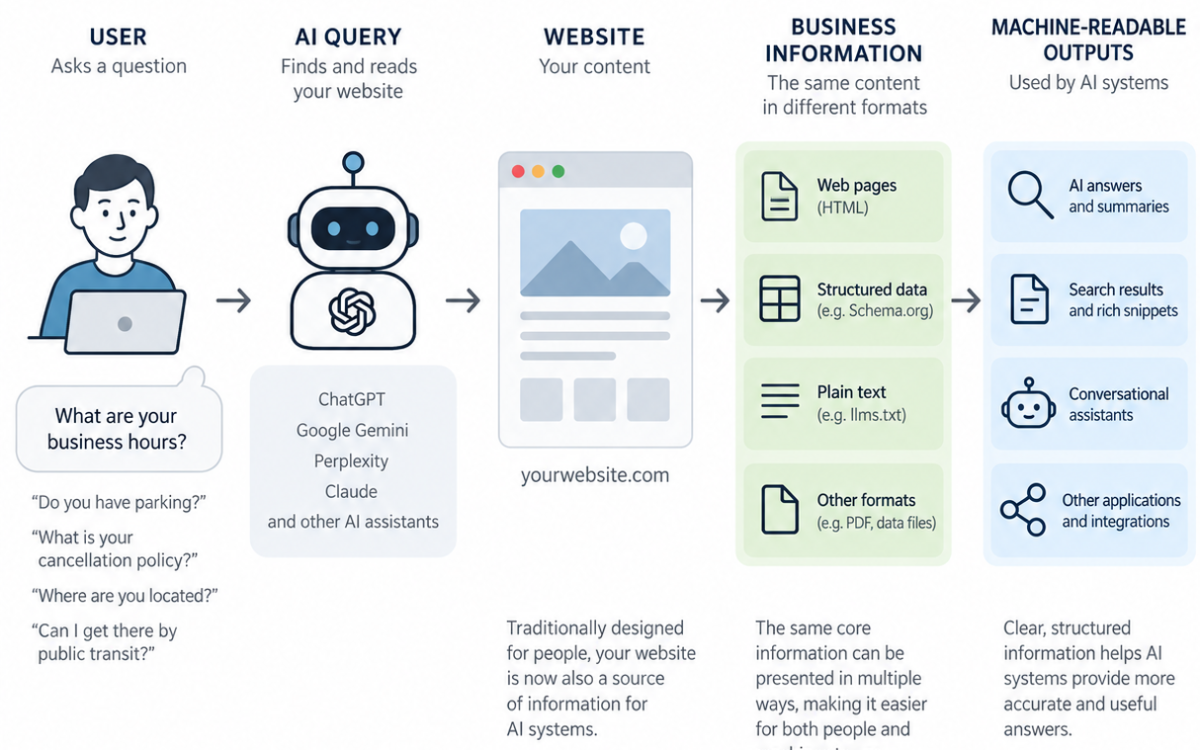
Owning a website does not mean expecting everyone to begin there. Publish in the channels your audience uses. Structure content so search and AI systems can understand it. Let useful pages travel.

The strategic advantage is having a durable source to travel from—and a place people can reach when they want the full answer.

Sources

CategoriesMarketing Technology

Your CRM Is Not Your Marketing Strategy

A CRM can make an organization feel more organized before it has decided what it is organizing for. Fields are configured, stages are named and dashboards appear. The difficult questions remain untouched.

Who is the priority customer? What problem do we solve well? Why should that person continue the relationship? Software cannot choose those answers.

A system records a model of the customer

Every CRM contains assumptions: what counts as a lead, which interactions matter, when a relationship changes state and who owns the next action. If those assumptions are vague, the database becomes a tidy record of inconsistent behaviour.

Configuration should follow a lifecycle the organization can explain in plain language.

Segmentation requires a reason

Creating more segments is easy. Useful segmentation changes an offer, message, service level or next action. If two groups receive the same treatment, the distinction may not deserve operational complexity.

Collect data because a decision needs it, not because a field exists.

Strategy sits outside the platform

Salesforce’s own CRM strategy guidance spans business processes, customer needs and analytics. That is broader than software setup. The platform supports choices about relationships; it does not originate them.

The same is true of automation. A journey builder can execute a sequence only after somebody decides what a respectful, useful sequence should be.

Judge the CRM by behaviour

Do teams trust the data? Are handoffs clearer? Do customers receive more relevant responses? Can leaders see where relationships stall and change the process?

A system that answers those questions is valuable. A system celebrated mainly for the number of records it holds is an expensive address book.

Sources

CategoriesDigital Strategy

AI Is Making Marketing Execution Cheap. Strategy Is Becoming More Valuable.

Marketing production is getting cheaper. A team can generate more copy, images, variations, summaries and campaign components in an afternoon than it could produce in a week.

That sounds like an advantage until every competitor can do the same thing.

Abundant output changes the bottleneck

When production was expensive, making the asset consumed much of the effort. AI shifts pressure upstream. Which audience matters? What promise is credible? What should be left unsaid? Which idea deserves repetition?

More output makes weak choices more visible, not less costly.

Strategy creates exclusion

A strategy is a set of choices that rules out attractive alternatives. Generative systems are excellent at offering alternatives. They are less suited to accepting responsibility for the one an organization selects.

Positioning depends on history, competitive reality and what the organization can consistently deliver. Prompt fluency does not replace that knowledge.

Productivity is not differentiation

McKinsey has estimated meaningful productivity potential for generative AI in marketing. Those gains matter, but efficiency spreads quickly when tools are broadly available. A faster production line does not create a reason to choose what comes off it.

Differentiation comes from insight, taste, evidence and coordinated execution over time.

Use the savings to think better

The bad outcome is filling every saved hour with more assets. The better outcome is spending more time with customers, testing claims, improving offers and editing harder.

AI can make execution cheap enough that judgment becomes the most expensive—and most valuable—part of marketing again.

Sources

CategoriesMarketing Leadership

The Problem With Outsourcing Your Digital Marketing Strategy

An agency can write the plan, build the deck and run the channels. It cannot own the consequences of the choices in the same way the organization does.

When strategy is fully outsourced, internal leaders often receive polished recommendations without building the capability to judge them.

Strategy depends on knowledge that is hard to transfer

Customer history, political constraints, service capacity, risk tolerance and the reasons previous attempts failed rarely fit neatly into a brief. Partners see the portion the organization manages to articulate.

That outside view is useful. It is not complete.

Keep the decisions inside

The organization should own the audience priority, value proposition, objectives, investment trade-offs, data access and definition of success. A partner can challenge those choices and show better options. The accountable leader still decides.

This boundary also prevents channel plans from masquerading as strategy. A list of campaigns is downstream of the choices that matter.

Use partners for advantage

External specialists can supply scarce expertise, pattern recognition, production scale and an honest view of internal habits. They are especially valuable when the mandate is clear and internal owners are available to work with them.

The relationship should leave behind stronger decisions, documentation and skills—not dependence on a presentation nobody inside can maintain.

Test for retained capability

Ask whether internal leaders can explain why the plan exists, access the accounts and data, change priorities, evaluate performance and replace a supplier without losing the strategy. If not, too much has been handed over.

Outsource work. Buy advice. Borrow experience. Keep the compass.

Sources

CategoriesGrowth & Measurement

Stop Reporting Marketing Activity. Start Reporting Business Impact.

A report can be accurate and still be useless. Marketing sent the emails, delivered the impressions and generated the clicks. Every number may be correct. The reader is left asking: so what?

Activity belongs in operational reporting. Leadership reporting needs a chain from activity to customer behaviour to an organizational outcome.

Begin with the outcome

Name the result the organization values: qualified demand, revenue, renewal, application completion, donation or reduced service cost. Then show the behaviours marketing can reasonably influence on the way there.

This prevents a channel metric from becoming a counterfeit business result. A high click rate can help explain performance; it is not the performance story.

Contribution is more honest than credit

Many journeys involve brand, search, sales, product experience and previous customer knowledge. Forcing one channel to receive full credit creates confidence the evidence cannot support.

Use experiments where possible. Elsewhere, show a reasoned contribution with assumptions and limits. Credibility grows when uncertainty is visible.

Add the decision

A useful readout says what changed, the likely reason, what the team proposes and what it expects to learn next. This turns reporting from defence into management.

Google Analytics organizes reports around objectives such as leads, sales and retention. Internal reporting should go further by connecting those measures to the organization’s definitions and economics.

Keep activity where it helps

Campaign teams still need delivery, frequency, creative response and funnel diagnostics. Put them one level down. Executives should be able to open the first page and understand the direction without learning each platform’s vocabulary.

Marketing earns confidence by explaining impact with discipline, not by presenting the largest available number.

Sources

CategoriesDigital Strategy

SEO After AI: What Still Matters?

AI answers have changed the visible surface of search. They have not removed the underlying problem: people still need reliable information, and systems still need to find, understand and evaluate it.

The temptation is to invent a new discipline for every interface change. Most organizations would get further by doing the old work properly.

Useful beats optimized-looking

Google’s guidance for AI search is blunt about non-commodity content. First-hand experience, original analysis and information that serves an intended audience are more durable than pages manufactured around every possible query variation.

That does not make structure irrelevant. Clear headings, explicit claims and self-contained explanations help both people and retrieval systems understand a page.

Technical access still matters

A crawler cannot recommend what it cannot reach. Indexing controls, internal links, canonical signals, page performance and accessible resources remain basic operating requirements. AI did not repeal HTTP.

Structured data can clarify meaning where it accurately represents visible content. It is not a substitute for the content itself.

Authority is earned outside the page

A perfectly edited article with no evidence or accountable author is easy to reproduce. Sources, demonstrated experience, a coherent body of work and links from trusted communities make a claim harder to dismiss.

Be precise about what you know and what you infer. Trust grows when readers can inspect the evidence.

Optimize for the satisfied visitor

Search interfaces will keep shifting between lists, summaries, conversations, images and video. The stable goal is to help a person complete the job that brought them there.

SEO after AI is less about finding a trick for the new results page and more about becoming a source worth retrieving. That standard is demanding. It is also refreshingly clear.

Sources