I recently came back from a trip to Europe and realized that I had travelled very differently this time.
I used an LLM for almost everything.
Trip planning. Getting around unfamiliar cities. Public transit. Finding things to see. Understanding signs and menus. Dealing with the language barrier. Figuring out what was open, where something was located, and how to get there.
Things that once required jumping between Google, transit websites, travel blogs, maps and translation apps increasingly happened through one conversation.
It worked remarkably well.
But the occasional mistakes were actually more interesting to me than the successes.
In several cases, the problem wasn’t necessarily that the AI couldn’t understand my question. It was that the information it was working with was messy, incomplete, ambiguous or difficult to extract from a conventional web page.
And that got me thinking about something much bigger than travel.
We built the web for people
For decades, the basic contract of the web has been fairly straightforward.
A business publishes information in HTML. A browser turns that HTML into something a person can read and interact with.
We have become very good at this.
Modern websites can be beautiful. We have navigation systems, responsive layouts, accordions, sliders, pop-ups, interactive maps, JavaScript applications and sophisticated visual hierarchies.
But increasingly, the person visiting your website may not be the one actually reading it.
A machine may read it first.
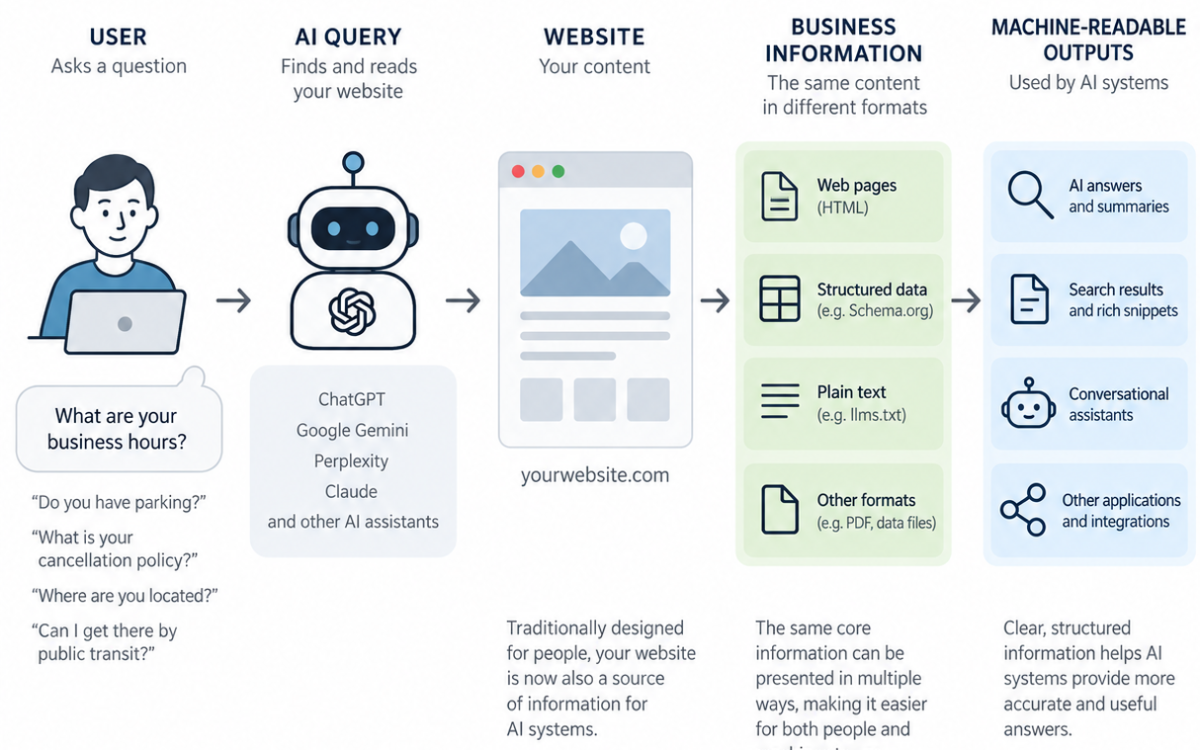
Someone might ask an AI assistant:
Does this hotel have parking?
What is the cancellation policy?
Is this business open on Sunday?
Which of these products is appropriate for a small business?
Can I get from the airport to this location by public transit?
The AI then has to find, interpret and assemble the answer.
That changes the problem.
HTML isn’t going away. But HTML alone may not be enough.
HTML is an extraordinary technology. It has survived decades of enormous change to the web.
But the meaning that seems obvious to a person looking at a rendered page isn’t necessarily equally obvious to software.
This isn’t a completely new problem.
We’ve been adding machine-readable layers to websites for years. XML sitemaps help search engines discover URLs. Structured data helps machines understand that something is a product, event, organization, review or offer.
Schema.org, for example, has spent years developing a shared vocabulary for describing information on the web in machine-understandable ways.
What is changing is the importance of the machine audience.
For traditional SEO, machine readability could influence how a page was indexed or appeared in search.
In an AI-mediated environment, it can influence the answer itself.
That’s a much higher stake.
We may need two versions of the web
I increasingly think businesses should start viewing their content as having at least two presentations.
The first is for people.
It should be attractive, persuasive, accessible and easy to navigate.
The second is for machines.
It should be structured, explicit, concise and extremely difficult to misunderstand.
We’re already seeing experimentation in this direction.
The emerging llms.txt proposal, for example, suggests giving AI systems a concise, LLM-friendly guide to important website content and potentially linking to cleaner Markdown versions of pages.
Whether llms.txt itself becomes a lasting standard is almost beside the point.
The important idea is this:
A website may no longer be just a collection of pages. It may also need to become a reliable source of structured knowledge about the organization behind it.
Think about content as data
This leads to a different way of thinking about websites.
Consider a hotel.
Its website contains room descriptions, rates, check-in times, amenities, parking information, cancellation rules, restaurant hours, addresses and contact information.
Traditionally, we think about how to arrange all of that into pages that are useful and persuasive to visitors.
But underneath those pages is something else:
information.
The webpage is simply one presentation of it.
The same underlying information could potentially be presented as HTML for visitors, structured data for machines, feeds for other systems, clean text for AI tools or through an API.
That changes the model from:
page → information
to:
information → multiple representations
I think this distinction is going to become increasingly important.
Your CMS should eventually do this automatically
I don’t think marketing teams should have to maintain five separate versions of every piece of information.
Eventually, a good content management system should allow an organization to maintain a reliable source of truth and automatically produce whatever representations are required.
HTML for people.
Structured data for machines.
Clean text or Markdown where appropriate.
APIs and feeds where appropriate.
Perhaps formats we haven’t invented yet.
We’re not completely there.
So for many organizations, some of this will remain manual work for a while.
Fortunately, we’ve been through something similar before.
SEO forced organizations to think beyond what a webpage looked like. We learned to care about page titles, metadata, XML sitemaps, canonical URLs, structured data and information architecture.
The AI transition isn’t starting from zero.
But the implications could be considerably broader.
What businesses can do now
I wouldn’t recommend rushing out and creating an “AI version” of every page on your website.
Start with the information itself.
Identify the questions people most frequently ask about your organization.
Make the answers easy to find.
Make your terminology consistent.
Don’t bury important facts inside clever marketing copy.
Use appropriate structured data.
Separate core information from its visual presentation wherever your technology allows it.
And start asking a new question whenever you publish important content:
Could a machine understand this correctly without seeing the page the way I do?
If the answer is no, there is probably work to do.
The web isn’t becoming less important
There has been plenty of discussion about AI reducing search traffic and potentially making websites less relevant.
I wonder if we’re looking at it backwards.
Websites may become even more important.
But their role may change.
Your website won’t only be a destination people visit.
It will increasingly be an authoritative source of information that search engines, assistants and AI agents consult when they need to understand your organization.
For the last 25 years, we’ve spent enormous effort making websites easier for people to use.
The next challenge may be making sure machines understand them just as well.
And I suspect that will become a surprisingly important part of digital marketing.